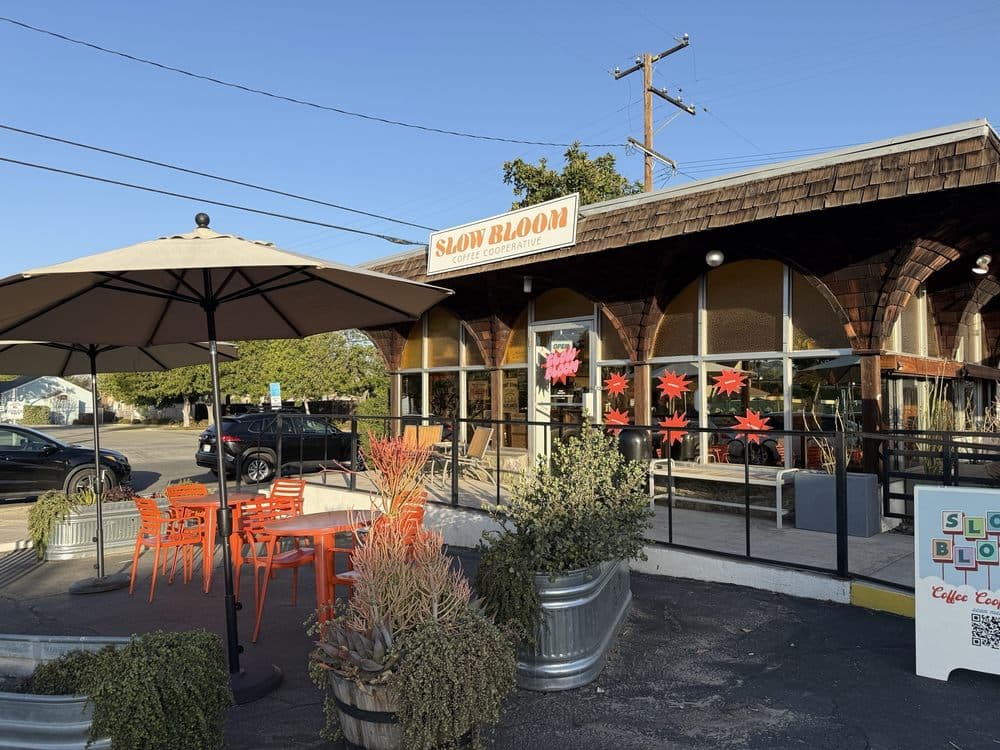
Slow Bloom Coffee
Curator’s note
The Guatemala page prints what the co-op paid Daniel Orantes: 2,700 Quetzal a quintal when the regional rate that season was 1,800, with the FOB and the shelf price sitting beside it. Almost no roaster publishes the number it paid a farmer, and the same instinct runs through the packaging, one design drawn after Sister Corita Kent's pop art and another after ordinary blue-collar work spaces.
Iced latte with peanut butter syrup and house strawberry sauce, or hot with peanut butter only.
The coffee
Lead Roaster Kelley Bader roasts what the co-op sells, and the 10-kilo Mill City machine he started on belongs to another roastery in town. Honduras takes five of the eleven listings on the shop page, from Erlan Odli Romero's washed Pacamara at 1,550 to 1,600 meters to a deliberate dark roast called Goth Phase, and neither listing prints a roast date.
- Honduras | Erlan Odli Romero - Washed Pacamara
- Pacamara
- Washed
- Erlan Odli Romero
cacao nibs · vanilla bean · toasted caramel
- Honduras | Yensi Sanchez - Anaerobic Washed Parainema
- Parainema
- Anaerobic Natural
- Yensi Sanchez
black tea · raisin · lemonade · dried fig
- Ethiopia | Koke Honey - Honey Landrace
- Kurume, Dega, Wolisho
- Honey
- Smallholders, Koke and Birbes Kele washing stations
passionfruit · blackberry jam · hops · peach tea · apricots
- Honduras | Danilo Sanchez - Anaerobic Natural Parainema
- Parainema
- Anaerobic Natural
- Danilo Sanchez
orange wine · lemon-lime candy · melon
- Guatemala | Daniel Orantes - Washed Mixed Varietal
- Pache San Ramon, Cogollo Blanco, Red Catuai
- Washed
- El Suyatal, Daniel Orantes
peach rings · cherry cola · watermelon · strawberry · caramel
- Dark Roast Honduras | Goth Phase - Washed Bourbon
- Dark
- Bourbon
- Washed
- Victoria Aguirre, Mi Bendicion lot
toasted marshmallow · butterscotch · burnt citrus
- Arm In Arm - Multi-Origin
- Parainema, Typica, Caturra, Landrace
- Washed/Natural
- Community lots
mixed berries · milk chocolate · citrus fruits · sweet and syrupy
The room
Stained and textured glass fronts the 888-square-foot room, white-painted Victoria Arduino Mythos grinders and a three-group Synesso S300 showing through it, with Portuguese terrazzo underfoot and a shaded patio outside. The building is midcentury modern, an arched shingle canopy over the glazed front and period-style lettering above the street number, and a room this small is right to put its machinery in the window rather than behind a wall.
The vibe
Photos
People
Been to Slow Bloom Coffee?
Leave a note for the next person: what to order, where to sit.